
New Haven Criminal History Checks
New Haven criminal records are divided by creator and stage. Town police holds its incident or arrest report. Municipal court holds a city-ordinance or local traffic case. Mason Magistrate Court holds state-law misdemeanors and felony preliminary proceedings. Circuit Court holds an indicted felony. WVDCR, not the town, operates the public regional-jail search.
- Call the official New Haven town channel and identify the police or municipal record custodian.
- Give the event date, location, event or citation number, and exact document sought.
- Search Mason County in MCRSearch when the charge was filed under state law.
- Use WVDCR Jails and Daily Incarcerations for booking or present regional custody.
- Contact the Mason Circuit Clerk if the felony advanced through indictment.
Use the first response to sharpen the next step. If town staff says the matter went to Magistrate Court, switch to the county case number instead of repeating a broad town request.
New Haven Records Without a Portal
No dedicated New Haven police report form, arrest blotter, app, or municipal-court case portal was verified. That means the correct digital answer is not a third-party people search. Start with the official New Haven town channel, ask for the current records custodian, and confirm how requests can be delivered. The town should also confirm any current copy charge before work begins.
A practical request includes requester contact information, event date, location, event number when known, a plain description of the report, desired format, and a request for a pre-charge estimate. Ask whether the town can send an electronic copy. If the response identifies a state-law court filing, use that case number with MCRSearch and the Magistrate Clerk. This fallback chain preserves the true local path without inventing a service New Haven does not publish.
Note: No online New Haven result is not proof that no town police report, municipal citation, or Mason County case exists.
Records at the New Haven Police Department
New Haven Police is the right starting office for a report written by a town officer. That report can contain event time, location, responding officers, alleged conduct, property or evidence, and an initial charge. Public portions may be released, while protected details can be removed. A Mason County Sheriff report is not interchangeable, even if later custody and court records use county names.
Before sending a written request, ask town staff to confirm that police remains the custodian and to state the accepted submission path. Research did not verify a separate records-unit name, street counter schedule, base fee, or report portal. Avoid guessing. A specific request is easier to route than “all criminal records” for a name, and it reduces the chance of drawing in unrelated files.
New Haven Police Records
Use official town contact
New Haven, West Virginia
Confirm current custodian
No verified online form
New Haven Arrest Records Go Statewide
New Haven is a small Ohio River town, yet its custody records enter the same statewide system used after arrests elsewhere in Mason County. The town had 1,485 residents in the 2020 Census and ranked second among the county's incorporated places. Its size does not create a town jail search or a separate felony court. Local police creates the first record, then county and state institutions create the later layers.
This is why geography can mislead a searcher. Point Pleasant is the county seat, but the city where court offices sit does not change the place of the original New Haven incident. Likewise, a WVDCR jail profile can document admission following a New Haven arrest while the arrest narrative remains at the town. Use the agency name and record type, not just the place name, in each request.
The same rule helps when two dates differ. The police event date marks the New Haven encounter. The WVDCR admission date marks intake. A magistrate filing date marks the start of the state court case, and a later indictment date marks the Circuit Court phase. Those dates can all be accurate. Match each one to the office that created it before treating a gap as an error.
Booking and Arrest Records in New Haven
A New Haven officer's arrest can generate a police report, a WVDCR booking, a Magistrate Court complaint and bail entry, fingerprint data for WVSP CIB, and later a Circuit Court file. Search WVDCR Offender Search and choose Jails for regional custody. Daily Incarcerations is a separate recent-admission view. Use Prison Search only for sentenced state-prison custody.
The jail search may ask for last name, optional first name, and a CAPTCHA. A missing person may still be in intake, listed under another spelling, released, transferred, or housed outside the expected system. Record the facility and admission identifiers if a profile appears. Do not treat the booking charge as the final charge. The prosecutor may amend or decline it, and the court disposition is the source for the outcome.
For changes in custody, WVDCR routes the public to VINE, an official-contractor notification tool.
VINE can support release or transfer notifications, but it is not a complete New Haven court or probation record.
New Haven Town or State Charge
A municipal citation and a state-law complaint can begin with the same local encounter but lead to different clerks. For a town ordinance or municipal traffic matter, contact the New Haven municipal court through town government. Give the citation number exactly, the name, and the approximate date. No verified public municipal docket was found, so the clerk must explain current lookup, copy, and certification methods.
If the charge cites West Virginia law or town staff says it was transferred, search Mason Magistrate Court. A state misdemeanor can remain there through disposition. A felony starts there for complaint, initial appearance, bail, and preliminary examination, then moves to Circuit Court after indictment. Asking “town ordinance or state charge?” early prevents a wasted New Haven record search.
- Municipal citation
- A town-issued case handled within lawful municipal jurisdiction.
- Complaint
- A sworn allegation that begins a magistrate criminal matter.
- Indictment
- A grand-jury felony charge that moves the trial file to Circuit Court.
- Disposition
- The recorded outcome, such as conviction, dismissal, or acquittal.
The New Haven Municipal Court File
The municipal court file is narrower than a full criminal history. It answers what happened to a matter within New Haven's municipal jurisdiction. Police may hold the narrative, while court staff holds the citation, docket events, plea, orders, disposition, and public financial entries. Ask for a certified disposition when the final outcome must be proved.
| Court | New Haven municipal court through official town government contact. |
|---|---|
| Case Types | Town ordinance and municipal traffic matters within lawful jurisdiction. |
| Lookup | Name, exact citation or case number, and approximate date; no verified public portal. |
| File Contents | Citation, docket events, pleas, public orders, disposition, and financial entries where present. |
| Copies and Fees | Confirm current format, certification, and price with the town clerk. |
A town file does not contain every later county record. If the case proceeded under state law, use the Mason court channel named by the clerk.
New Haven Magistrate Record Search
The free Magistrate Case Record Search accepts a first name, last name, or case number and can be narrowed to Mason County where the filter appears. It returns up to 30 records and no scanned documents. A common name can hit the cap. Use a full spelling and the exact case number when available.
Online absence can result from a spelling issue, a city matter that never entered state court, a filing delay, an older or archived file, or a case outside magistrate jurisdiction. The official Mason County court directory lists Karen Chambers's Magistrate Clerk office at 304-675-6840 for the actual complaint, order, bond entry, or certified disposition. The office is at 200 Sixth Street in Point Pleasant.
The state magistrate records law explains why the index and clerk channels work together for New Haven state cases.
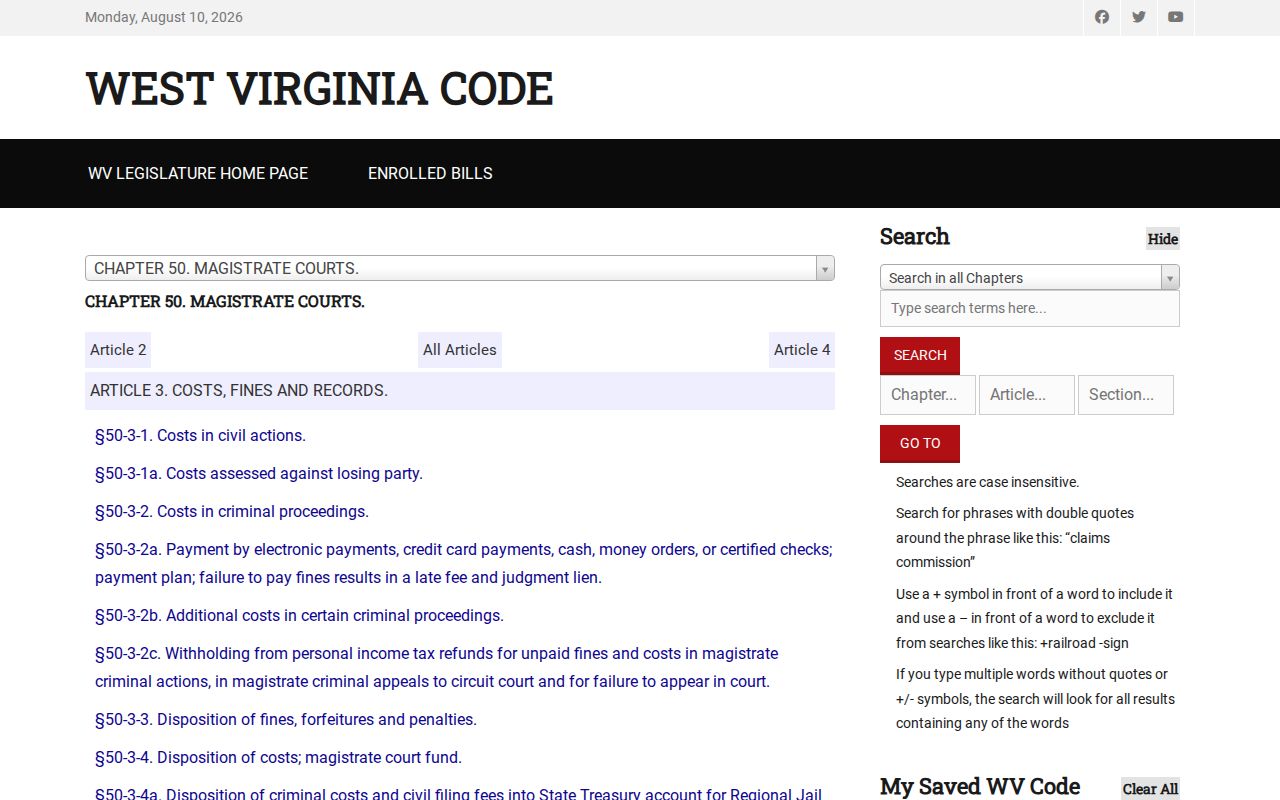
The official law supports public searches while also recognizing fees, exceptions, and the need to obtain documents from the proper clerk.
New Haven Felony Record Timeline
A felony record does not begin in Circuit Court. After a New Haven arrest, a magistrate handles the complaint, initial appearance, bail, and preliminary stage. The prosecutor can present the matter to a grand jury. If an indictment follows, Mason Circuit Court creates the felony trial file. The docket may then show arraignment, discovery, motions, plea or trial, disposition, and sentence.
Call the Circuit Clerk at 304-675-4400 with the defendant name and approximate filing year. The Mason County office list confirms the weekday courthouse schedule and local phone channels. Ask for the case number, docket sheet, indictment, final disposition, sentence order, and current copy or certification cost. Mason County has no verified open circuit-document portal with scanned files. That clerk route is essential when a New Haven felony disappears from the limited online view or when the full judgment is needed.
How New Haven Records Reach County
The records move by law and work process, not by one all-purpose database. New Haven Police keeps its report. Magistrate or Circuit Court creates the judicial record. Officers and jail staff send qualifying fingerprints and descriptions to the West Virginia State Police Criminal Identification Bureau, while courts report sentences and other dispositions. A court correction may not update each downstream system at once.
Record flow: New Haven Police › Mason County Courts › West Virginia State Police Criminal Identification Bureau
For a recent New Haven event, compare the police request, WVDCR entry, and magistrate case. For an indicted felony, add the Circuit Clerk file. For your own fingerprint-linked statewide history, use WVSP's authorized review process. The Mason County court case lookup gives the county process more depth while the town page stays focused on New Haven's first record.
Correcting New Haven Record Outcomes
If an arrest cycle still appears open after dismissal or another disposition, start with the court that entered the outcome. Obtain the case number and a certified disposition. Ask the arresting agency or clerk to correct its source data. For a wrong entry in your own CIB history, West Virginia State Police Form 136A provides the personal review and challenge route, with a published $20 check or money-order charge.
An eligible dismissed, acquitted, or qualifying diversion record may fall under W. Va. Code §61-11-25. Eligible convictions use §61-11-26 and have exclusions and process rules that must be checked in the live statute. Expungement is not instant across the New Haven police, court, WVDCR, and CIB systems. Recheck each relevant source after the order has been processed.
Keep certified copies of the disposition and any expungement order. Those records give each custodian a clear basis for review.
New Haven Record Access Rules
The West Virginia Freedom of Information Act applies to nonexempt town police records. A custodian may redact victim, minor, medical, financial, or protected identifying data and may withhold qualifying active-investigation or security-sensitive content. Ask for segregable public parts instead of assuming one exemption closes the whole New Haven report.
Key statutes:
W. Va. Code §29B-1-3 creates inspection and copy rights for nonexempt public records.
W. Va. Code §29B-1-4 identifies exemptions that can support redaction or withholding.
W. Va. Code §50-3-4 governs magistrate criminal-record searches, fees, and exceptions.
WVSP CIB is different from the town and court indexes. Under §15-2-24(d), release outside government or law enforcement requires written, acknowledged subject authorization and superintendent approval. Use public court files for ordinary name searching.